
Many business owners ask, is QuickBooks a ERP system? While QuickBooks offers powerful accounting features, it differs from a
Qasim Raza | QuickBooks Expert


Accounting & Bookkeeping
QuickBooks
 By qasimquickbooks416@
August 11, 2026
By qasimquickbooks416@
August 11, 2026
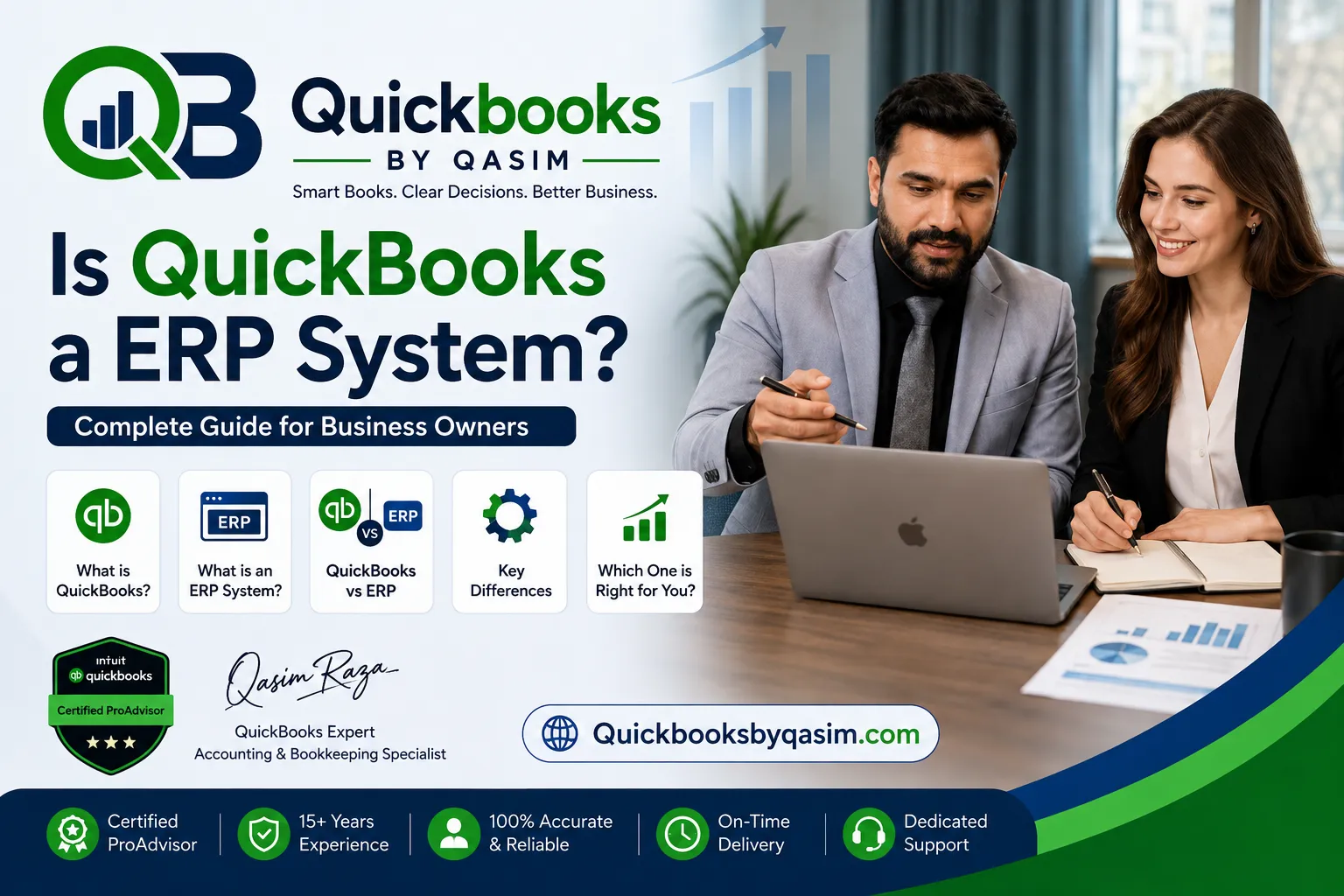
Is QuickBooks a ERP System?
 By qasimquickbooks416@
August 11, 2026
By qasimquickbooks416@
August 11, 2026
Introduction
Is QuickBooks a ERP system is a question many growing businesses ask. As companies expand, they need better control over accounting, inventory, operations, reporting, and customer management. However, many owners feel confused when comparing accounting software with enterprise solutions. As a QuickBooks Online Expert, I often help businesses understand where QuickBooks fits and whether an ERP system makes sense for their needs.
The short answer is no. QuickBooks is primarily accounting software. However, it shares some features with ERP platforms. Therefore, understanding the differences helps you choose the right solution for your business. In this guide, I will explain what ERP software does, how QuickBooks compares, and when businesses should upgrade.
What Is an ERP System?
ERP stands for Enterprise Resource Planning. An ERP system combines multiple business functions into one platform.
A typical ERP system manages:
- Accounting
- Purchasing
- Inventory
- Manufacturing
- Human Resources
- Supply Chain
- Customer Management
- Reporting
Instead of using separate tools, businesses manage everything from one centralized system. As a result, teams can access the same data and work more efficiently.
Large and growing businesses often choose enterprise resource planning software because it improves visibility and automates complex processes.
Is QuickBooks a ERP System?
The simple answer remains no.
Is QuickBooks a ERP system? Not technically. QuickBooks Online is accounting software designed for small and medium-sized businesses. It focuses on bookkeeping, invoicing, expenses, payroll, reporting, and tax management.
However, QuickBooks offers several features commonly found in ERP software. For example, it manages financial data, tracks inventory, and generates business reports.
Nevertheless, QuickBooks does not provide the complete functionality of a traditional ERP system. It lacks many advanced operational tools that larger organizations require.
Therefore, while QuickBooks supports business management, it does not qualify as a full enterprise resource planning software solution.
What QuickBooks Does Well
QuickBooks Online remains one of the most popular accounting solutions available today.
Key features include:
- Income and expense tracking
- Invoicing
- Accounts payable
- Accounts receivable
- Bank reconciliation
- Payroll management
- Financial reporting
- Basic inventory management
These features make QuickBooks an excellent choice for startups and small businesses.
Moreover, QuickBooks Online offers cloud access. Consequently, business owners can manage finances from almost anywhere.
For many businesses, QuickBooks delivers everything needed without investing in a costly ERP system.
QuickBooks vs ERP System
Many users researching is QuickBooks a ERP system actually want to understand the differences.
Scope
QuickBooks focuses mainly on accounting.
An ERP system manages accounting plus operational departments.
Complexity
QuickBooks offers a simple user experience.
By comparison, enterprise resource planning software often requires extensive implementation and training.
Cost
QuickBooks typically costs much less.
ERP solutions often involve higher setup, customization, and maintenance expenses.
Scalability
QuickBooks supports business growth.
However, larger organizations may outgrow its capabilities.
An ERP system handles complex workflows, multiple locations, and advanced operational requirements.
Integration
QuickBooks relies heavily on third-party applications.
On the other hand, an ERP platform includes many business functions within a single solution.
Features Found in ERP Systems but Not QuickBooks
If you still wonder, is QuickBooks a ERP system, consider these advanced ERP capabilities.
Most ERP platforms provide:
- Manufacturing management
- Advanced inventory control
- Supply chain management
- Production planning
- Warehouse management
- Multi-entity management
- Advanced procurement
- Enterprise automation
These features help large organizations streamline operations.
Although QuickBooks integrates with many applications, it does not include these functions natively.
Therefore, businesses with highly complex processes often choose an ERP system instead.
When QuickBooks Is the Right Choice
QuickBooks works well for many organizations.
You may benefit from QuickBooks if:
- You run a startup.
- You own a small business.
- Your inventory needs are basic.
- Your accounting processes are straightforward.
- Your team wants simple software.
- Your budget is limited.
In these situations, purchasing a full ERP system may create unnecessary costs and complexity.
Consequently, QuickBooks provides greater value for many small businesses.
When Your Business May Need an ERP System
As companies grow, business needs change.
You may need enterprise resource planning software if:
- You manage multiple warehouses.
- You operate across several locations.
- You have manufacturing processes.
- You require advanced inventory tracking.
- You need detailed operational reporting.
- You manage large purchasing operations.
Additionally, businesses that depend on automation often benefit from an ERP system.
If manual processes consume valuable time, ERP software may improve efficiency significantly.
Can QuickBooks Work with ERP Solutions?
Yes.
Many businesses use QuickBooks together with ERP-related applications.
For example, companies often connect QuickBooks with:
- Inventory management software
- CRM platforms
- E-commerce solutions
- Project management tools
- Warehouse systems
As a result, businesses can extend QuickBooks functionality while avoiding a complete ERP migration.
This approach often provides a cost-effective solution during growth phases.
Popular ERP Alternatives
Businesses evaluating is QuickBooks a ERP system often compare QuickBooks with ERP platforms.
Popular ERP options include:
- Oracle NetSuite
- Microsoft Dynamics 365
- SAP Business One
- Acumatica
- Odoo ERP
- Sage X3
These solutions offer broader functionality than QuickBooks.
However, they also require greater investment and implementation effort.
Therefore, businesses should evaluate requirements carefully before upgrading.
Advantages of Staying with QuickBooks
Many businesses continue using QuickBooks successfully for years.
Major advantages include:
- Easy setup
- Lower costs
- User-friendly interface
- Strong reporting
- Cloud accessibility
- Extensive app integrations
- Reliable accounting features
Because of these benefits, QuickBooks remains a leading accounting solution for small businesses worldwide.
Conclusion
So, is QuickBooks a ERP system? No, QuickBooks is not a true ERP system. It is powerful accounting software designed for small and medium-sized businesses. While it shares some features with an ERP system, it does not provide the full operational capabilities found in enterprise resource planning software.
For businesses with basic accounting and management needs, QuickBooks Online remains an excellent choice. However, companies with complex operations, multiple departments, or advanced inventory requirements may benefit from a dedicated ERP platform. By understanding the differences, you can select the right solution that supports both your current needs and future growth.