Many business owners, students, and new accountants feel the same. IFRS can sound hard at first. But it’s not as scary as it looks.
IFRS means International Financial Reporting Standards. These are accounting rules that help companies make clear financial reports. Many countries use IFRS to make business reports easy to compare. The International Financial Reporting Standards Foundation is used across 170 jurisdictions worldwide.
IFRS means International Financial Reporting Standards.
These standards guide how companies prepare financial reports. They help people read and compare company accounts. IFRS Accounting Standards are set by the International Accounting Standards Board, also called IASB.
A company uses IFRS when it makes reports like:
Statement of financial position
Statement of profit or loss
Statement of cash flows
Statement of changes in equity
Notes to financial statements
These reports show the health of a business.
For example, they show:
What the company owns
What the company owes
How much money it earned
How much money it spent
How cash moved in and out
So, IFRS helps Stakeholders to see a clear cash flow of the company.
Why Do People Use IFRS?
People use International Financial Reporting Standards because business needs trust.
Investors want clear reports. Banks want fair deposit numbers. Owners want better decisions. Governments also need clean records and reports.
IFRS helps all these people read financial reports more easily.
It gives one common reporting language. This matters more when companies work across countries.
For example, a company in Saudi Arabia may deal with a company in Europe. If both use IFRS, their reports become easier to compare.
That saves time. It also builds trust.
Main Benefit of IFRS
The main benefit of International Financial Reporting Standards is better comparison.
Companies may work in different countries. But they can still report using similar rules.
This helps:
Investors compare companies efficiency report.
Banks check loan risk
Owners see business results
Auditors check accounts
Managers make better plans
So, IFRS makes reports more useful.
Simple Meaning of IFRS
Think of IFRS like traffic rules.
Roads need rules so people can drive safely. Accounting also needs rules so people can report fairly.
Without rules, each company may show its financial reports in its own way.
That can confuse readers.
It gives clear rules for reports. So, readers can trust the financial figures more.
What Is the Purpose of IFRS?
International Financial Reporting Standards helps companies prepare clear and fair financial reports.
These reports should help users make good choices.
Users may include:
Business owners
Investors
Banks
Tax teams
Auditors
Suppliers
Customers
Government bodies
Each user needs clear financial data.
For example, a bank may check a company’s reports before giving a loan. An investor may check profit before buying shares.
So, it helps users make smart money choices.
Why IFRS Matters in 2026
IFRS still matters in 2026 because business is global.
Companies now sell, buy, invest, and borrow across borders. So, they need reports that people can understand in many places.
It helps create that common base.
The IFRS Foundation says, it monitors International Financial Reporting Standards use across jurisdictions to track global adoption. It has complete profiles for 170 jurisdictions.
This shows that IFRS has a strong global role.
In 2026, many companies also care about:
Transparent reports
Better audits
Cross-border sales
Investor trust
Clear bank records
Strong governance
What Is IASB?
IASB means International Accounting Standards Board.
IASB sets International Financial Reporting Standards Accounting Standards. The IFRS for SMEs third edition was issued by the International Accounting Standards Board.
IASB does not run a company.
Instead, it makes accounting standards.
These standards help companies report financial data in a clear way.
IASB also reviews standards over time. It updates them when business needs change.
For example, IASB issued the third edition of IFRS for SMEs in February 2025. The new edition applies from periods starting on or after 1 January 2027, with early use allowed.
So, IASB keeps International Financial Reporting Standards fresh and useful.
Why IASB Is Important
IASB is important because standards need a clear owner.
If no one manages standards, rules can become weak.
IASB helps by:
Writing IFRS Standards
Updating old standards
Reviewing business needs
Supporting global reporting
Making rules more useful
This helps companies follow better reporting rules.
It also helps users trust financial reports.
IFRS and Financial Statements
IFRS mainly deals with financial statements.
Financial statements tell the story of a business.
They show where money came from. They also show where money went.
Common reports include:
Statement of financial position
Statement of profit or loss
Statement of cash flows
Statement of changes in equity
Notes to accounts
Each report has a different job.
Together, they show the full picture.The way these reports are presented is just as important as the numbers inside them. Our IAS 1 Financial Statements Presentation guide explains the key presentation rules used under IFRS.
Statement of Financial Position
This report shows what a company owns and owes.
It also shows owner equity.
You may know it as a balance sheet.
It includes:
Assets
Liabilities
Equity
Assets are things the company owns.
Liabilities are amounts the company owes.
Equity is the owner’s share.
This report helps readers see business strength.
Statement of Profit or Loss
This report shows income and expenses.
It tells if a company made profit or loss.
It includes:
Sales
Cost of sales
Expenses
Finance costs
Tax
Profit or loss
This report helps users see business performance.
If profit is rising, the business may look strong.
If losses continue, users may ask questions.
Statement of Cash Flows
This report shows cash movement.
Profit and cash are not always the same.
A company may show profit but still have low cash.
So, cash flow matters a lot.
The report often has three parts:
Operating cash flow
Investing cash flow
Financing cash flow
It helps users see how money moves.
Notes to Financial Statements
Notes explain the numbers.
They give more details about the reports.
Notes may explain:
Accounting policies
Key estimates
Risks
Debts
Leases
Revenue details
Related party balances
So, notes help users understand reports better.
IFRS vs GAAP
Many beginners ask this question.
What is the difference between IFRS and GAAP?
IFRS means International Financial Reporting Standards.
GAAP means Generally Accepted Accounting Principles.
GAAP can refer to local accounting rules. In many cases, people use GAAP to mean US GAAP.
The main difference is simple.
IFRS is used in many countries. US GAAP is mainly used in the United States.
IFRS is often seen as more principle-based. US GAAP is often seen as more rule-based.
That means IFRS gives more broad guidance. GAAP often gives more detailed rules.
IFRS vs GAAP: Simple Table
Area
IFRS
GAAP
Full name
International Financial Reporting Standards
Generally Accepted Accounting Principles
Main use
Many countries
Mainly United States
Style
More principle-based
More rule-based
Standard setter
IASB
FASB in the US
Global focus
Strong global use
Strong US use
Main goal
Clear global reports
Clear local reports
Why IFRS vs GAAP Matters
This difference matters when companies work globally.
A company may report under IFRS in one country. Another company may report under GAAP in the US.
Investors must understand the difference.
Otherwise, they may compare numbers in the wrong way.
For example, revenue, leases, and asset values may differ.
So, IFRS vs GAAP can affect decisions.
Which Is Better: IFRS or GAAP?
Neither is always better.
Both systems have value.
IFRS works well for global comparison. GAAP works well in the US market.
The best choice depends on:
Country rules
Company type
Investor needs
Stock exchange rules
Legal needs
Reporting goals
So, companies follow the rules that apply to them.
Where Is IFRS Used?
IFRS is used in many parts of the world.
The IFRS Foundation, lists jurisdiction profiles that show where IFRS is required or allowed. It has followed by 170 jurisdictions.
These profiles include countries and regions such as:
Saudi Arabia
United Arab Emirates
United Kingdom
European Union
Australia
New Zealand
South Africa
Singapore
Malaysia
Pakistan
Oman
Qatar
Bahrain
The exact rule can differ by country.
Some countries require IFRS for listed companies. Fewer allow IFRS in certain cases. Some use local rules based on IFRS.
So, always check your local law.
IFRS in Saudi Arabia
IFRS matters in Saudi Arabia too.
Saudi businesses, accountants, and tax practitioners often need to understand IFRS.
Companies may need IFRS reports for:
Audits
Banks
Investors
ZATCA records
Management review
Group reporting
Tender support
If your business needs professional guidance with IFRS implementation, financial reporting, or compliance requirements, you can explore our IFRS consulting services for practical support tailored to your business needs.
In KSA, IFRS knowledge can help accountants serve better clients.
It can also support tax and zakat work.
Good financial reports make tax review easier.
IFRS for SMEs
SME means small and medium-sized entities.
Many small companies don’t need full IFRS.
Full IFRS can be too long and complex for smaller businesses.
So, IASB created IFRS for SMEs.Many owners use the terms SMEs and small businesses in the same way. If you want a practical overview of IFRS for small businesses, this guide explains the key rules, benefits, and reporting requirements in simple terms.
The IFRS Foundation says IFRS for SMEs uses simplifications from full IFRS. Some topics are removed because they don’t fit typical SMEs. It also needs fewer disclosures and uses simple executions.
which makes it easier for small businesses.
What Is IFRS for SMEs?
IFRS for SMEs is a simpler accounting standard.
It helps smaller businesses prepare clear reports.
Removes some topics that small businesses may not need.
Reduces long note requirements.
The IFRS Foundation says the IFRS for SMEs Standard has fewer disclosures and simpler text than full IFRS.
So, it saves time for many small companies.
IFRS for SMEs Updates
IFRS for SMEs has changed over time.
The IFRS Foundation says the Standard was updated in February 2025. The new edition becomes effective for periods starting on or after 1 January 2027. Early use is allowed.
This means 2026 is a good planning year.
SMEs and accountants can study the new edition early.
They can also prepare staff and systems.
This helps avoid stress before the effective date.
Who Can Use IFRS for SMEs?
IFRS for SMEs is for entities without public accountability.
EY explains that IFRS for SMEs can apply to entities that don’t have public accountability and publish general-purpose financial statements.
In simple words, it fits many private businesses.
But each country decides its own rules.
So, a business must check local law first.
A company should also ask its auditor or adviser.
Benefits of IFRS
IFRS makes financial reports easier to compare.
IFRS helps investors understand company outputs.
IFRS supports better trust in financial statements.
IFRS helps banks review business reports.
IFRS gives a common accounting language.
IFRS helps companies work across borders.
IFRS helps auditors check reports more clearly.
IFRS can improve business decision-making.
IFRS helps owners see profit, assets, and debts.
IFRS supports clearer notes and disclosures.
IFRS can help groups prepare common reports.
IFRS helps students learn global accounting.
IFRS may increase investor confidence.
IFRS supports better financial discipline.
IFRS helps management find money risks early.
How to IFRS
Here, “How to IFRS” means how to start learning and using IFRS.
Learn the basic meaning of IFRS.
Read simple guides before full standards.
Understand the main financial statements.
Study revenue, leases, assets, and inventory.
Learn the role of IASB.
Compare IFRS with local rules.
Review IFRS rules for your country.
Check if IFRS for SMEs applies.
Use examples from real financial reports.
Ask an auditor when rules seem unclear.
Keep notes for each key standard.
Update your knowledge every year.
Train your accounting team slowly.
Use checklists during month-end closing.
Review reports before final approval.
Common IFRS Standards
There are many IFRS and IAS Standards.
Some are very common in daily accounting.
A beginner should know these first.
Below are key standards explained in simple words.
IFRS 15: Revenue From Contracts With Customers
IFRS 15 deals with revenue.
Revenue means the money a company earns from sales.
This standard explains when a company should record revenue.If you want a deeper understanding of IFRS 15 revenue recognition, this guide explains when revenue should be recognized, how contracts affect reporting, and the key steps companies follow under the standard. It also includes simple examples to make the rules easier to understand.
It also explains how much revenue to record.
For example, a company may sell goods or services.
IFRS 15 helps decide when that sale becomes income.
This matters because revenue affects profit.
The updated IFRS for SMEs aligns its revenue section with IFRS 15, with simpler rules for SMEs.
IFRS 16: Leases
IFRS 16 deals with leases.
A lease means a company uses an asset owned by someone else.
For example, a company may lease:
Office space
Vehicles
Machines
Warehouses
Equipment
IFRS 16 changed how many leases appear in accounts.If you want a deeper understanding of IFRS 16 lease accounting, this guide explains right-of-use assets, lease liabilities, and key lease reporting rules in simple terms. It also includes practical examples to help you apply the standard correctly.
It often brings lease assets and lease liabilities into reports.
This helps users see lease duties more clearly.
IFRS 9: Financial Instruments
IFRS 9 deals with financial instruments.
This can include:
Loans
Receivables
Payables
Bank balances
Investments
Some contracts
IFRS 9 companies measure financial assets and liabilities.
It also deals with expected credit losses.If you want to learn more about IFRS 9 financial instruments, this guide explains expected credit losses, asset classification, and financial liabilities in simple terms. It also includes practical examples to make the standard easier to understand.
That means companies must think about bad debts earlier.
This standard matters most for banks and finance-heavy firms.
IFRS 10: Consolidated Financial Statements
IFRS 10 deals with group accounts.
A parent company may control other companies.
Those other companies are called subsidiaries.
IFRS 10 helps decide when a parent must prepare group reports.
Group reports show the parent and subsidiaries together.
This helps users see the whole group clearly.
The 2025 IFRS for SMEs update includes alignment with IFRS 10 concepts about control.
IFRS 13: Fair Value Measurement
IFRS 13 deals with fair value.
Fair value means the price in an orderly market deal.
This standard helps companies measure fair value.
It also guides disclosures about fair value.
Fair value can apply to investments, property, or instruments.
The 2025 IFRS for SMEs update added a section on fair value measurement based on IFRS 13.
IAS 2: Inventories
IAS 2 deals with inventory.
Inventory means goods held for sale.
It can include:
Raw materials
Work in progress
Finished goods
IAS 2 helps companies value inventory.If you want a deeper understanding of IAS 2 inventory accounting, it helps to see how inventory is measured, valued, and reported under IFRS. This includes common inventory methods and practical reporting examples.
It also explains cost and net realizable value.
This matters for profit and asset values.
If inventory is wrong, profit may also be wrong.
IAS 16: Property, Plant, and Equipment
IAS 16 deals with fixed assets.
These are long-term assets used in business.
Examples include:
Buildings
Machines
Vehicles
Tools
Furniture
Office equipment
IAS 16 explains how to record and depreciate assets.If you want a deeper look at IAS 16 Property, Plant and Equipment, this guide explains asset recognition, depreciation, useful life, and disposal in a simple way. It also includes practical examples to help you apply the standard correctly.
Depreciation spreads asset cost over useful life.
This helps match cost with business use.
IAS 38: Intangible Assets
IAS 38 deals with assets you can’t touch.
These are called intangible assets.
Examples include:
Software
Licenses
Patents
Trademarks
Brand rights
This standard explains when to record them.
It also explains how to measure them.
Not every idea becomes an asset.
So, this standard needs careful study.
IAS 37: Provisions and Contingencies
IAS 37 deals with uncertain liabilities.
A provision means a likely duty with an uncertain amount or timing.
For example, a company may expect a legal claim.
It may need to record a provision.
IAS 37 helps decide when to record it.
It also guides disclosure of possible risks.
This matters because hidden risks can mislead users.
IAS 12: Income Taxes
IAS 12 deals with income taxes.
It covers current tax and deferred tax.
Current tax is tax for the current year.
Deferred tax comes from timing differences.
This standard can feel hard for beginners.
But it’s very important for proper reporting.
Tax numbers can affect profit and equity.
IAS 7: Statement of Cash Flows
IAS 7 deals with cash flow statements.
Cash flow shows how cash moved.
It helps users see real cash strength.
A company may earn profit but lack cash.
So, cash flow is very important.
IAS 7 splits cash flows into key sections.
These are operating, investing, and financing activities.
IAS 8: Accounting Policies, Estimates, and Errors
IAS 8 deals with accounting choices and corrections.
It guides companies when they:
Choose accounting policies
Change estimates
Correct errors
This standard helps reports stay fair and clear.
For example, depreciation life may change.
That is an estimate change.
But a wrong past entry may be an error.
IAS 1: Presentation of Financial Statements
It guides how companies show financial statements.
It covers key reports and main presentation rules.
A good presentation helps readers scan reports faster.
It also helps companies avoid confusing formats.
Clear reports support better decision-making.If you want to understand these reporting requirements in more detail, see our guide on IAS 1 Financial Statements Presentation. It explains how IFRS financial statements should be structured and presented to users.
IFRS for Beginners: Key Terms
IFRS has many terms.
But beginners can start with simple words.
Here are important terms.
Assets
Assets are things a company owns or controls.
They can bring future benefits.
Examples include:
Cash
Inventory
Machines
Buildings
Receivables
Software
Assets show business resources.
Liabilities
Liabilities are amounts a company owes.
They may come from loans, bills, or contracts.
Examples include:
Bank loans
Supplier payables
Tax payable
Lease liabilities
Accrued expenses
Liabilities show business duties.
Equity
Equity is the owner’s share in the business.
It is what remains after liabilities.
Simple formula:
Assets minus liabilities equals equity.
Equity may include:
Share capital
Retained earnings
Reserves
It shows the net value for owners.
Income
Income is money earned by the business.
It can come from sales or other sources.
Examples include:
Product sales
Service income
Rental income
Interest income
Income increases profit.
Expenses
Expenses are costs used to earn income.
Examples include:
Salaries
Rent
Utilities
Fuel
Repairs
Depreciation
Expenses reduce profit.
Good expense tracking helps control costs.
Profit
Profit is income minus expenses.
If income is higher, the company makes profit.
If expenses are higher, the company makes a loss.
Profit shows business performance.
But profit is not the same as cash.
So, always check cash flow too.
Why IFRS Helps Investors
Investors need clear reports before they invest.
They want to know if a company is strong.
IFRS helps them check:
Profit
Debt
Cash flow
Assets
Risks
Growth
Clear reports reduce confusion.
They also make comparison easier.
For example, an investor may compare two companies.
If both use IFRS, the review becomes easier.
Why IFRS Helps Banks
Banks use financial statements before giving loans.
They need to know if the business can repay.
IFRS reports can help banks check:
Cash flow
Debt level
Profit trend
Asset base
Risk notes
This helps banks make better loan choices.
It also helps businesses present stronger records.
Why IFRS Helps Business Owners
Business owners need clean numbers.
They can’t run a business by guessing.
IFRS-style reporting helps owners see:
What they own
What they owe
Where profit comes from
Where money goes
Which costs are rising
Which assets need review
This helps owners make better plans.
It also supports growth.
Why IFRS Helps Accountants
IFRS helps accountants follow clear rules.
It gives structure to financial reporting.
Accountants use IFRS to:
Record transactions
Prepare reports
Make disclosures
Review estimates
Support audits
Explain results
IFRS knowledge also improves career value.
Many employers need accountants who understand IFRS.Employers often test practical IFRS knowledge during interviews. Reviewing common IFRS interview questions can help accountants prepare clear answers and demonstrate their understanding of financial reporting concepts.
IFRS and Auditing
Auditors check financial reports.
They need to know the reporting framework.
If a company uses IFRS, auditors check reports against IFRS.
This helps confirm if reports are fair.
Good IFRS records can make audits smoother.
Poor records can create audit issues.
So, accountants should keep support for each key number.
IFRS and Tax
IFRS and tax are not always the same.
This is very important.
IFRS helps prepare financial reports.
Tax rules decide taxable income.
Sometimes, accounting profit and tax profit differ.
That is normal.
For example, tax law may treat expenses differently.
So, companies should keep tax records too.
Accountants must understand both sides.
IFRS and ZATCA
In Saudi Arabia, tax and zakat work need proper records.
IFRS reports can support better account review.
But ZATCA rules and IFRS rules may differ.
So, don’t assume IFRS profit equals tax base.
Always check local tax rules.
You should also keep clean documents.
This includes invoices, contracts, and bank proof.
Benefits of IFRS for SMEs
It is simpler than full IFRS.
It removes topics that many SMEs don’t need.
It asks for fewer disclosures.
It uses clearer language than full IFRS.
It helps SMEs prepare better reports.
It can improve bank loan files.
It can support investor trust.
It can help owners understand results.
It can reduce reporting burden.
It can support better audits.
The IFRS Foundation says IFRS for SMEs has simplifications, fewer disclosures, and plain English text.
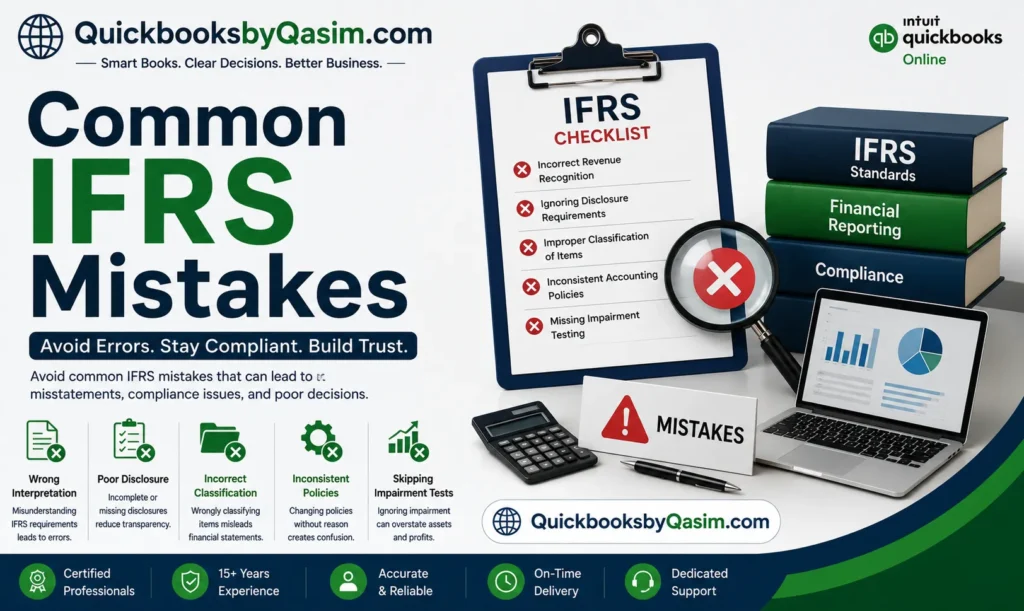
Common IFRS Mistakes
Mixing IFRS and tax rules without review.
Recording revenue too early.
Ignoring lease accounting.
Forgetting to review bad debts.
Using old asset values without testing.
Missing financial statement notes.
Treating all costs as assets.
Not keeping support documents.
Copying reports from another company.
Ignoring related party transactions.
Not updating accounting policies.
Forgetting cash flow review.
Using wrong inventory values.
Not checking local IFRS rules.
Waiting until audit time to fix errors.
Common IFRS Mistake: Revenue Timing
Revenue can be tricky.
Some businesses record revenue too early.
This can overstate profit.
For example, a company may receive advance money.
But it may not complete the service yet.
In that case, revenue may need care.
IFRS 15 helps guide revenue timing.
So, always check the contract first.
Common IFRS Mistake: Weak Notes
Financial statement notes matter.
Many beginners focus only on numbers.
But notes explain the story behind numbers.
Weak notes can confuse readers.
They can also create audit questions.
Good notes should explain:
Policies
Estimates
Risks
Related parties
Loans
Leases
Commitments
So, don’t ignore notes.
Common IFRS Mistake: Poor Asset Records
Fixed assets need proper records.Understanding IAS 16 Property Plant and Equipment Explained can help businesses maintain better asset records and avoid common reporting errors. It covers how assets should be recorded, depreciated, and reviewed over time.
A company should track:
Purchase date
Cost
Useful life
Location
Depreciation
Disposal date
Asset condition
Without records, assets become hard to manage.
This can affect profit and balance sheet values.
It can also create audit issues.
Common IFRS Mistake: Ignoring Impairment
Some assets lose value.
This is called impairment.
For example, a machine may become damaged.
A customer balance may become doubtful.
A store may close or lose sales.
In such cases, values may need review.
Ignoring impairment can make reports look better than truth.
So, review assets often.
Helpful Tips
Start with the basic IFRS meaning.
Learn one standard at a time.
Use simple examples while studying.
Read real listed company reports.
Make your own IFRS checklist.
Keep all source documents safe.
Review contracts before recording revenue.
Check leases before closing accounts.
Match bank balances every month.
Review receivables for bad debts.
Update accounting policies when needed.
Ask experts when rules seem unclear.
Train the team before year-end.
Don’t wait until audit time.
Keep tax and IFRS files separate.
Helpful Tip: Use a Monthly Checklist
A checklist helps you avoid small mistakes.
Use it every month.
Your checklist can include:
Bank reconciliation
Sales review
Expense review
Payroll review
Inventory check
Asset additions
Lease review
Receivables aging
Payables aging
Tax accruals
Closing entries
Management review
This keeps records cleaner.
It also saves time at year-end.
Helpful Tip: Keep Documents Ready
IFRS reporting needs proof.
Every big number should have support.
Keep documents like:
Invoices
Contracts
Purchase orders
Delivery notes
Bank statements
Loan papers
Lease agreements
Payroll records
Tax filings
Good documents help audits.
They also help management trust the reports.
Helpful Tip: Learn IFRS Slowly
Don’t try to learn all IFRS in one week.
That can feel heavy.
Start with daily accounting topics.
First, learn revenue.
Next, learn expenses.
Then, learn assets and liabilities.
After that, move to leases and taxes.
This method feels easier.
It also helps you remember more.
How IFRS Improves Business Decisions
Good reports lead to good choices.
IFRS helps management see clear numbers.
For example, management can ask:
Is profit rising?
Is cash enough?
Are costs too high?
Are customers paying late?
Is debt too heavy?
Are assets useful?
Are risks growing?
These questions help leaders act fast.
So, IFRS is not only for auditors.
It also helps daily business planning.
IFRS and Business Growth
Growing businesses need better reports.
Small errors may not hurt at first.
But they become serious as business grows.
For example, a company may open more branches.
It may hire more staff.
Take bank loans.
Seek investors.
At that stage, clean IFRS reports help.
They show that the company takes finance seriously.
IFRS and Global Trade
Global trade needs trust.
A buyer in one country may not know the seller.
A bank may not know a foreign customer.
An investor may compare many companies worldwide.
IFRS supports trust by giving common reporting rules.
This makes business talks easier.
It also helps companies enter new markets.
IFRS and Technology
Accounting software can help with IFRS.
But software alone is not enough.Many beginners also confuse accounting software with accounting standards. Our guide on IFRS vs QuickBooks explains the difference between financial reporting rules and the software used to record transactions.
You still need accounting knowledge.
Software can record data.
But accountants must choose the right treatment.
For example, software may post invoice revenue.
But IFRS may require review of contract terms.
So, technology helps.
But judgment still matters.
IFRS for Students
Students should learn IFRS early.
It can help in many careers.
You may work as:
Accountant
Auditor
Tax practitioner
Finance officer
Bookkeeper
Financial analyst
Business owner
IFRS knowledge builds a strong base.
It also helps you understand global business.
Start with simple terms.
Then read the standards step by step.
IFRS for Bookkeepers
Bookkeepers record daily transactions.
They may not prepare full IFRS reports.
But IFRS knowledge still helps them.Many bookkeepers use software every day, but software and reporting standards serve different purposes. Understanding IFRS vs QuickBooks can help clarify how bookkeeping tools support IFRS reporting.
It helps with:
Correct coding
Proper documents
Better expense records
Asset tracking
Revenue support
Month-end closing
Good bookkeeping supports good IFRS reports.
Bad bookkeeping creates reporting problems.
So, bookkeepers play a key role.
IFRS for Tax Practitioners
Tax practitioners also benefit from IFRS knowledge.
Business owners don’t need to know every standard.
But they should know the basics.
They should understand:
Profit
Cash flow
Debt
Assets
Equity
Risks
Tax difference
This helps them ask better questions.
It also helps them manage accountants better.
A smart owner doesn’t ignore financial reports.
IFRS Checklist for Beginners
Use this simple checklist.
Do you know what IFRS means?
Do you know your local reporting rules?
Do you know if full IFRS applies?
Do you know if IFRS for SMEs applies?
Do you have clean source documents?
Do you review revenue contracts?
Do you track fixed assets?
Do you review bad debts?
Do you prepare cash flow reports?
Do you review notes to accounts?
Do you update accounting policies?
Do you ask your auditor when unsure?
Simple IFRS Example
Let’s use a small example.
A company sells office chairs.
It sends chairs to a customer.
The customer agrees to pay later.
The company must decide when to record revenue.
It should check the sales terms.
It should confirm delivery and control transfer.
Then it can record revenue if IFRS rules are met.
This simple process helps avoid wrong profit.
Another IFRS Example
A company leases a delivery van.
It uses the van for business.
The lease lasts for several years.
Under IFRS, the company may need to record a lease asset.
It may also record a lease liability.
This shows users the company has a long-term duty.
So, leases don’t stay hidden.
IFRS and Management Reports
Management reports are internal reports.
They help owners and managers run the business.
IFRS reports are formal financial reports.
But both can work together.
For example, IFRS reports show yearly results.
Management reports show monthly trends.
Together, they help better planning.
This gives owners a clearer picture.
IFRS and Internal Control
Internal control means checks inside the business.
These checks reduce errors and fraud.
Strong controls help IFRS reporting.
Examples include:
Approval for payments
Bank reconciliation
Stock count
Invoice matching
Asset tagging
User access control
Manager review
Good controls keep data clean.
Clean data makes reporting easier.
IFRS and Documentation
Documentation is very important.
If you record a number, keep proof.
This is true for:
Sales
Expenses
Loans
Assets
Payroll
Inventory
Taxes
Leases
Without proof, reports become weak.
Auditors may also ask for support.
So, keep files organized.
IFRS and Estimates
Some IFRS areas need estimates.
An estimate is a careful accounting judgment.
Examples include:
Useful life of assets
Bad debt allowance
Inventory write-down
Warranty provision
Fair value
Impairment loss
Estimates should be reasonable.
They should also have support.
Don’t guess without evidence.
IFRS and Accounting Policies
Accounting policies are rules the company follows.
They guide how transactions are recorded.
Examples include policies for:
Revenue
Inventory
Depreciation
Leases
Financial instruments
Foreign currency
Provisions
Policies should match IFRS.
They should also stay consistent.
If policies change, explain the change clearly.
IFRS and Disclosure
Disclosure means extra details in notes.
Disclosure helps users understand numbers.
For example, debt balances need more detail.
Users may need to know:
Interest rate
Due date
Security
Covenants
Repayment terms
This information helps users judge risk.
So, disclosure is not just extra text.
It is part of clear reporting.
IFRS Adoption Challenges
IFRS can bring challenges.
Beginners may find some rules hard.
Businesses may also face system issues.
Common challenges include:
Staff training
Data quality
System setup
Contract review
Note preparation
Audit support
Policy changes
Time limits
But these challenges can be managed.
Start early and use checklists.
How to Start IFRS in a Small Business
Start with your current accounts.
Don’t jump into complex rules first.
First, clean your basic records.
Then review major areas.
Use this simple order:
Clean your chart of accounts.
Reconcile bank accounts.
Review all sales invoices.
Review unpaid customer balances.
Check supplier balances.
List fixed assets.
Review loans and leases.
Prepare basic financial reports.
Add clear notes.
Ask an expert to review.
This step-by-step method works well.If you’re running a smaller company, it also helps to understand how IFRS for small businesses applies in real situations. This can make reporting, audits, and financial planning much easier.
IFRS Learning Plan
A simple training plan can help.
1st Week 1:
Learn IFRS meaning.
Learn financial statements.
Learn key terms.
2nd Week :
Study revenue.
Study expenses.
Study inventory.
3rd Week :
Study fixed assets.
Study leases.
Study loans.
4th Week :
Study cash flows.
Study notes.
Review examples.
This plan keeps learning easy.
IFRS and Its Flow
IFRS Reports for Banks
Banks often ask for financial statements.
They may ask for audited reports too.
A clean IFRS report can support a loan file.
It may show:
Stable profit
Strong cash flow
Reasonable debt
Good assets
Clear notes
This helps the bank review credit risk.
But banks may still ask for more documents.
So, keep all support ready.
IFRS Reports for Investors
Investors need trust before putting money in.
They want clear and fair reports.
IFRS helps show the real business picture.
Investors may review:
Revenue growth
Profit margin
Cash flow
Debt level
Asset quality
Risk notes
Related party deals
Clear reports make these reviews easier.
They also reduce doubt.
IFRS and Related Parties
Related party transactions need care.
A related party may include owners, directors, or group companies.
Transactions with related parties can affect fairness.
For example, a company may sell goods to an owner-related firm.
Readers need to know if terms are fair.
So, IFRS disclosure can help show transparency.
This builds trust in reports.
IFRS and Inventory Count
Inventory is a common risk area.
Businesses should count stock regularly.
They should compare actual stock with records.
This helps find:
Missing stock
Damaged goods
Slow-moving items
Wrong entries
Cost errors
Good inventory records support correct profit.Inventory valuation also affects financial reporting. Our IAS 2 Inventory Accounting Explained guide shows how businesses account for inventory and apply key IFRS inventory rules.
They also support better cash planning.
IFRS and Receivables
Receivables are amounts customers owe.
Not all customers pay on time.
Some may never pay.
So, companies must review receivables.
They should check:
Age of balances
Customer payment history
Disputes
Legal cases
Collection chances
This helps record expected credit losses.Expected credit losses are an important part of IFRS 9 Financial Instruments Guide.Understanding these rules can help businesses assess receivable risks and prepare more accurate financial reports.
It also avoids overstated assets.
IFRS and Payables
Payables are amounts the company owes.
These include supplier invoices and accruals.
A company should review payables often.
Missing payables can overstate profit.
For example, a company may receive services but no invoice yet.
It may still need an accrual.
So, month-end review matters.
IFRS and Accrual Accounting
IFRS uses accrual accounting.
This means companies record income and expenses when they happen.
They don’t wait only for cash.
For example, you may sell on credit.
You record revenue when earned.
You don’t wait for customer payment.
This gives a better view of performance.
But cash flow still needs review.
IFRS and Cash Basis
Cash basis records items when cash moves.
This method is simpler.
But it may not show full business performance.
For example, unpaid bills may stay hidden.
IFRS financial reports usually use accrual accounting.
So, accountants must understand timing.
This helps match income and expenses better.
IFRS and Fair Presentation
Fair presentation means reports show a true economic picture.
This is a key idea in reporting.
Financial statements should not hide major facts.
They should not mislead readers.
Numbers should match proper accounting rules.
Notes should explain important details.
This helps users trust the report.
IFRS and Professional Judgment
IFRS often needs judgment.
Rules don’t answer every case with one line.
Accountants must use facts and logic.
They should also keep supporting themselves.
Good judgment uses:
Contracts
Evidence
Business facts
Standard guidance
Past results
Expert advice
Never make a judgment without support.
IFRS and Ethics
Ethics matter in accounting.
Accountants should report honestly.
They should not hide losses.
Not inflate income.
Not change Financial numbers to please others.
IFRS works best when people act with honesty.
Good standards need good ethics.
Without ethics, reports can still mislead.
IFRS and Year-End Closing
Year-end closing is important.
This is when final reports are prepared.
A good closing process includes:
Bank reconciliation
Sales review
Expense accruals
Inventory count
Asset review
Lease review
Tax review
Related party check
Notes preparation
Don’t wait until last week.
Start early and review often.
IFRS and Month-End Closing
Month-end closing helps keep records clean.
It prevents year-end pressure.
Each month, review:
Cash
Sales
Purchases
Payroll
Inventory
Assets
Payables
Receivables
Loans
Taxes
This makes year-end much easier.
It also helps managers act faster.
IFRS and Chart of Accounts
A chart of accounts is the account list.
It organizes all accounting entries.
A good chart helps IFRS reporting.
Use clear account names.
Avoid too many duplicate accounts.
Group accounts properly.
For example:
Sales
Cost of sales
Salaries
Rent
Fixed assets
Loans
VAT payable
A clean chart saves time.
IFRS and Accounting Software Setup
Software setup affects reporting quality.
If setup is poor, reports may be poor.
Set up:
Account codes
Tax codes
Customer records
Supplier records
Asset register
Inventory items
User roles
Report formats
Then review reports monthly.
Software should support your accounting process.
It should not replace your judgment.
IFRS and Small Business Loans
Small businesses often need bank loans.
Banks may ask for clear accounts.
IFRS or IFRS for SMEs can help make accounts more trusted.
The IFRS for SMEs Standard aims to meet SME needs with simplified rules and fewer disclosures than full IFRS.
This can help smaller businesses present stronger reports.
But local rules still matter.
Always check what your bank needs.
IFRS and Company Valuation
Valuation means finding business value.
Investors may use financial reports for valuation.
They check:
Revenue
Profit
Cash flow
Debt
Assets
Growth
Risk
If reports are unclear, valuation becomes harder.
IFRS can help by improving clarity.
It also helps users compare companies.
IFRS and Cross-Border Groups
Many groups have companies in many countries.
They need one reporting base.
IFRS can help group reporting.
A parent company may ask all units to report under IFRS.
This makes consolidation easier.
It also reduces confusion.
Group finance teams can compare units better.
That helps better control.
IFRS and Foreign Currency
Some companies deal in foreign currency.
They may buy or sell in dollars, euros, or other currencies.
Foreign currency accounting can affect profit.
Exchange rates may change.
Companies must record gains or losses properly.
This area needs care.
It also needs strong documentation.
IFRS and Leases for Small Firms
Small firms often rent offices, cars, or equipment.
Lease accounting can be important.
A lease may affect assets and liabilities.Understanding IFRS 16 Lease Accounting Explained can help businesses account for lease contracts correctly. It covers how lease assets and lease obligations are recognized and reported under IFRS.
So, firms should list all lease contracts.
They should check:
Lease start date
Lease term
Payment amount
Renewal options
Asset details
Discount rate
This helps avoid missing lease duties.
IFRS and Revenue Contracts
Revenue starts with contracts.
A contract may be written or agreed in another way.
Before recording revenue, check:
Revenue reporting depends on contract terms and performance obligations. Our IFRS 15 Revenue Recognition Explained guide shows how businesses apply these rules and avoid common revenue reporting mistakes.
What was promised?
Has the company delivered?
What is the price?
Are there discounts?
Are there returns?
Is payment likely?
This helps create correct revenue records.
It also reduces audit issues.
IFRS and Cost Control
IFRS reports can help cost control.
Expenses show where money goes.
Managers can compare current costs with past costs.
They can find rising costs early.
For example, fuel or overtime may increase.
Reports help managers ask why.
Then they can take action.
So, accounting can improve operations.
IFRS and Profit Quality
Profit quality means how reliable profit is.
High-quality profit comes from real business activity.
Low-quality profit may come from one-time gains.
IFRS notes can help users understand profit quality.
Users should check:
Revenue source
Expense trend
One-time items
Cash collection
Bad debt risk
Related party deals
This gives a clearer view.
IFRS and Cash Flow Quality
Cash flow quality is also important.
A company may show profit but poor cash.
This can happen when customers pay late.
It can also happen when inventory grows too much.
Cash flow reports help users see this issue.
Managers should review cash flow often.
Cash keeps the business alive.
IFRS and Risk Management
IFRS reports can show business risks.
Risks may include:
Credit risk
Liquidity risk
Market risk
Tax risk
Lease risk
Legal risk
Inventory risk
Disclosures help users understand these risks.
Good risk reporting supports better decisions.
It also builds trust.
IFRS and Future Planning
Good financial reports help future planning.
Management can use reports to plan:
Hiring
Purchases
Loans
New branches
Stock levels
Cash needs
Tax payments
IFRS helps make these reports more reliable.
Better data leads to better plans.
So, IFRS supports long-term success.
IFRS for SMEs vs Full IFRS
Full IFRS is broader.
IFRS for SMEs is simpler.
The IFRS Foundation states that IFRS for SMEs removes some topics, limits some policy choices, simplifies many measurement rules, needs fewer disclosures, and uses plain English.
Here is the simple difference:
Area
Full IFRS
IFRS for SMEs
Users
Larger or public companies
Smaller private entities
Detail
More detailed
More simple
Disclosures
More notes
Fewer notes
Topics
More topics
Some topics removed
Updates
More frequent
Less complex
Use
Based on local law
Based on local law
Should SMEs Use IFRS for SMEs?
SMEs should first check local law.
Then they should check business needs.
IFRS for SMEs may help if the business needs:
Bank loans
Investor reports
Cleaner books
Audit support
Better management data
Group reporting
But it may not fit every case.
So, ask your accountant or auditor.
Also, check if your country allows it.
How to Learn IFRS Faster
You can learn IFRS faster with a simple plan.
Don’t start with a full technical text.
Start with examples.
Use this order:
Learn accounting basics.
Learn financial statements.
Learn key IFRS words.
Study revenue first.
Study assets next.
Study leases after that.
Study cash flows.
Study notes and disclosures.
Read sample reports.
Practice with small cases.
This keeps learning simple.Many learners also follow a structured study path to stay focused. An IFRS certification guide can help you choose the right training, build a study plan, and prepare for exams step by step. This makes learning more organized and easier to track.
Best IFRS Learning Sources
Use trusted sources first.
Good sources include:
IFRS Foundation website
IASB updates
Audit firm guides
University material
Professional body courses
Real annual reports
The IFRS Foundation provides official information about IFRS Standards and jurisdiction use.
Official sources are better for key rules.
Blogs can help explain simple ideas.
But don’t rely only on blogs for final decisions.
IFRS Study Method for Beginners
Use this simple method.
First, read the topic name.
Next, learn the purpose.
Then, read a small example.
After that, solve one practice case.
Finally, write a short summary.
This method helps you remember.
It also keeps study stress low.
Repeat it for each standard.
IFRS Questions to Ask Before Closing Accounts
Ask these questions before final reporting.
Did we record all revenue correctly?
Did we record all expenses?
Did we review unpaid customer balances?
Did we review inventory values?
Did we record all loans?
Did we review lease contracts?
Did we update fixed assets?
Did we check tax balances?
Did we prepare notes?
Did management review the reports?
These questions can catch many issues.
IFRS and Audit Preparation
Audit preparation should start early.
Don’t wait for the auditor’s request list.
Prepare files in advance.
Keep folders for:
Cash and bank
Sales
Purchases
Payroll
Inventory
Fixed assets
Loans
Leases
Taxes
Legal matters
Related parties
This makes audit work smoother.
It also saves time.
IFRS and Management Responsibility
Management owns the financial statements.
Accountants prepare the reports.
Auditors check them.
But management must approve them.
So, managers should understand key numbers.
They should not sign reports blindly.
They should ask questions.
Good questions improve report quality.
IFRS and Small Company Culture
Small companies may not like formal reports.
They may feel reports are only for banks.
But clear reports help owners too.
They show business health.
Cash needs.
Avoid surprise losses.
So, even small firms should value good accounting.
IFRS and Business Trust
Trust is a big part of business.
Clear reports build trust.
They help users believe the numbers.
This can support:
Bank loans
Supplier credit
Investor talks
Partner deals
Better audits
IFRS helps support that trust.
But the company must still keep honest records.
IFRS and Decision-Making Example
Imagine two companies.
Company A has clear IFRS reports.
Company B has messy records.
A bank reviews both.
Company A can show profit, cash, and debt clearly.
Company B can’t explain its numbers.
The bank may trust Company A more.
This shows why good reporting matters.
IFRS and Clean Bookkeeping
IFRS starts with clean bookkeeping.
If daily entries are wrong, reports will be wrong.
So, focus on daily discipline.
Record sales on time.
Record expenses correctly.
Match bank accounts monthly.
Review customer balances.
Track assets.
These simple habits support IFRS reporting.
IFRS and Communication
Accountants must explain numbers clearly.
Good IFRS knowledge helps communication.
You can explain:
Why profit changed
Why cash is low
Why debt increased
Why assets changed
Why tax differs
Why notes matter
This helps owners and managers understand reports.
Clear communication adds real value.
IFRS and Career Growth
IFRS can help your career.
Many employers value IFRS skills.If you’re preparing for a finance or accounting role, it helps to review common IFRS interview questions and answers before your interview. This can improve your confidence and help you explain key IFRS concepts more clearly.
This applies to:
Accounting jobs
Audit jobs
Finance jobs
Tax jobs
Reporting jobs
Advisory jobs
IFRS knowledge shows you understand global reporting.
It can also help you serve better clients.
So, learning IFRS is a smart move. A certification can also help prove your IFRS knowledge to employers. Our guide to IFRS certification explains common certification options, study tips, and how professional credentials can support career growth.
Practical IFRS Example for SMEs
A small trading company buys goods.
It sells them to customers.
It has rent, salaries, and transport costs.
Its key IFRS areas may include:
Revenue
Inventory
Receivables
Payables
Fixed assets
Leases
Cash flow
Tax balances
The company doesn’t need to study everything first.
It should focus on what affects its business most.
This practical method saves time.
Practical IFRS Example for Service Firms
A service firm sells time and skill.
It may not hold much inventory.
Its key IFRS areas may include:
Service revenue
Staff costs
Receivables
Contract terms
Software costs
Leases
Tax balances
The firm should review service contracts.
It should also track work completed.
This helps revenue reporting.
Practical IFRS Example for Contractors
Contractors may have long projects.
Their accounting can be more complex.
They must track:
Contract revenue
Project costs
Work progress
Variations
Claims
Retention balances
Advances
Project losses
IFRS reporting helps show project results.
But contractors need strong records.
Project accounting needs close review.
IFRS Readiness Checklist for 2026
Use this checklist for 2026.
Review your reporting framework.
Check if full IFRS applies.
Check if IFRS for SMEs applies.
Study updates to IFRS for SMEs.
Train your accounting team.
Review your chart of accounts.
Clean old balances.
Update asset records.
Review lease contracts.
Improve monthly closing.
Prepare better notes.
Keep audit files ready.
Ask experts about complex areas.
The IFRS Foundation says the 2025 IFRS for SMEs edition becomes effective for periods starting on or after 1 January 2027, with early use allowed.
So, 2026 is a good year to prepare.
Frequently Asked Questions
What does IFRS mean?
IFRS means International Financial Reporting Standards. These are accounting rules for financial reports. They help companies show clear and useful financial information.
Who makes IFRS Standards?
The International Accounting Standards Board makes IFRS Accounting Standards. It works under the IFRS Foundation.
Is IFRS used in the USA?
The USA mainly uses US GAAP. IFRS is used in many other jurisdictions. The exact reporting rule depends on the company and market.
What is IFRS for SMEs?
IFRS for SMEs is a simpler standard for small and medium-sized entities. It has fewer disclosures and simpler rules than full IFRS.
Is IFRS hard to learn?
IFRS can look hard at first. But you can learn it step by step. Start with basic terms, financial statements, and simple examples.
Conclusion
IFRS is a global accounting language.
It helps companies prepare clear financial reports. It also helps investors, banks, owners, and auditors understand business results.
In this guide, you learned:
IFRS means International Financial Reporting Standards.
IASB sets IFRS Accounting Standards.
IFRS helps make reports easier to compare.
IFRS and GAAP are not the same.
Many jurisdictions use or allow IFRS.
IFRS for SMEs gives smaller firms simpler rules.
Common standards include IFRS 15, IFRS 16, IFRS 9, and IAS 2.
Clean records make IFRS reporting much easier.
If you’re new to IFRS, don’t rush.
First, learn the basic terms. Next, study one standard at a time. Also, use simple examples. Finally, ask an expert when a rule feels unclear.
IFRS may look difficult at the start. But with practice, it becomes much easier.
A clear report builds trust. And trust helps every business grow.




 By qasimquickbooks416@
August 10, 2026
By qasimquickbooks416@
August 10, 2026

 By qasimquickbooks416@
August 10, 2026
By qasimquickbooks416@
August 10, 2026
10 Comments