
Learn IFRS 15 in simple terms. Discover the five-step revenue recognition model, key rules, practical examples, and common
Qasim Raza | QuickBooks Expert


Financial Management
International Financial Reporting Standards
 By qasimquickbooks416@
August 29, 2026
By qasimquickbooks416@
August 29, 2026
IFRS 15 Revenue Recognition Explained
 By qasimquickbooks416@
August 29, 2026
By qasimquickbooks416@
August 29, 2026
Have you ever wondered when a company should record a sale?
Many people think a company records revenue when it gets paid. That’s not always true. Companies must follow rules to decide the right time.
The quick answer is simple. IFRS 15 tells companies when and how to record revenue.
This standard helps businesses show clear and fair results. It also helps investors, lenders, and managers make better choices.
In this guide, you’ll learn:
- What IFRS 15 is
- Why companies use it
- The main benefits
- The five-step model
- Common mistakes
- Helpful tips
- Answers to common questions
Let’s start.
What Is IFRS 15 Revenue Recognition Explained?
IFRS 15 is an accounting standard.
It tells companies how to record revenue from customer contracts.
The main goal is simple. Companies should record revenue when they deliver goods or services.
Before IFRS 15, different industries often used different rules.
That made reports hard to compare.
IFRS 15 created one model for many types of businesses.
A company can sell products.
A company can also provide services.
In both cases, IFRS 15 gives clear guidance.
People use IFRS 15 because they want consistent financial reports.
Clear reports help investors understand business performance.
They also help banks make lending decisions.
The main benefit is trust.
When companies follow IFRS 15, readers can better understand revenue figures.
A Simple Example
Imagine a company sells a laptop.
The customer orders today.
The laptop ships next week.
The company records revenue when it transfers control of the laptop.
It does not simply wait for payment.
It focuses on when the customer receives control.
This idea sits at the center of IFRS 15.
Why Revenue Recognition Matters
Revenue is a key number.
Investors look at it first.
Managers track it often.
Banks review it carefully.
If revenue appears too early, profits can look too high.
If revenue appears too late, results can look weak.
IFRS 15 helps avoid these problems.
It gives companies a clear path to follow.
As a result, financial statements become more useful.
Benefits of IFRS 15 Revenue Recognition Explained
- Creates one revenue model for many industries.
- Makes financial reports easier to compare.
- Helps investors understand company performance.
- Reduces confusion about revenue timing.
- Improves trust in financial statements.
- Gives clear rules for contracts.
- Helps companies record revenue consistently.
- Supports better business decisions.
- Reduces reporting errors.
- Helps meet IFRS requirements.
- Improves transparency.
- Makes audits easier.
- Provides guidance for complex sales deals.
- Helps businesses track contract obligations.
- Gives users a clearer financial picture.
How to IFRS 15 Revenue Recognition Explained
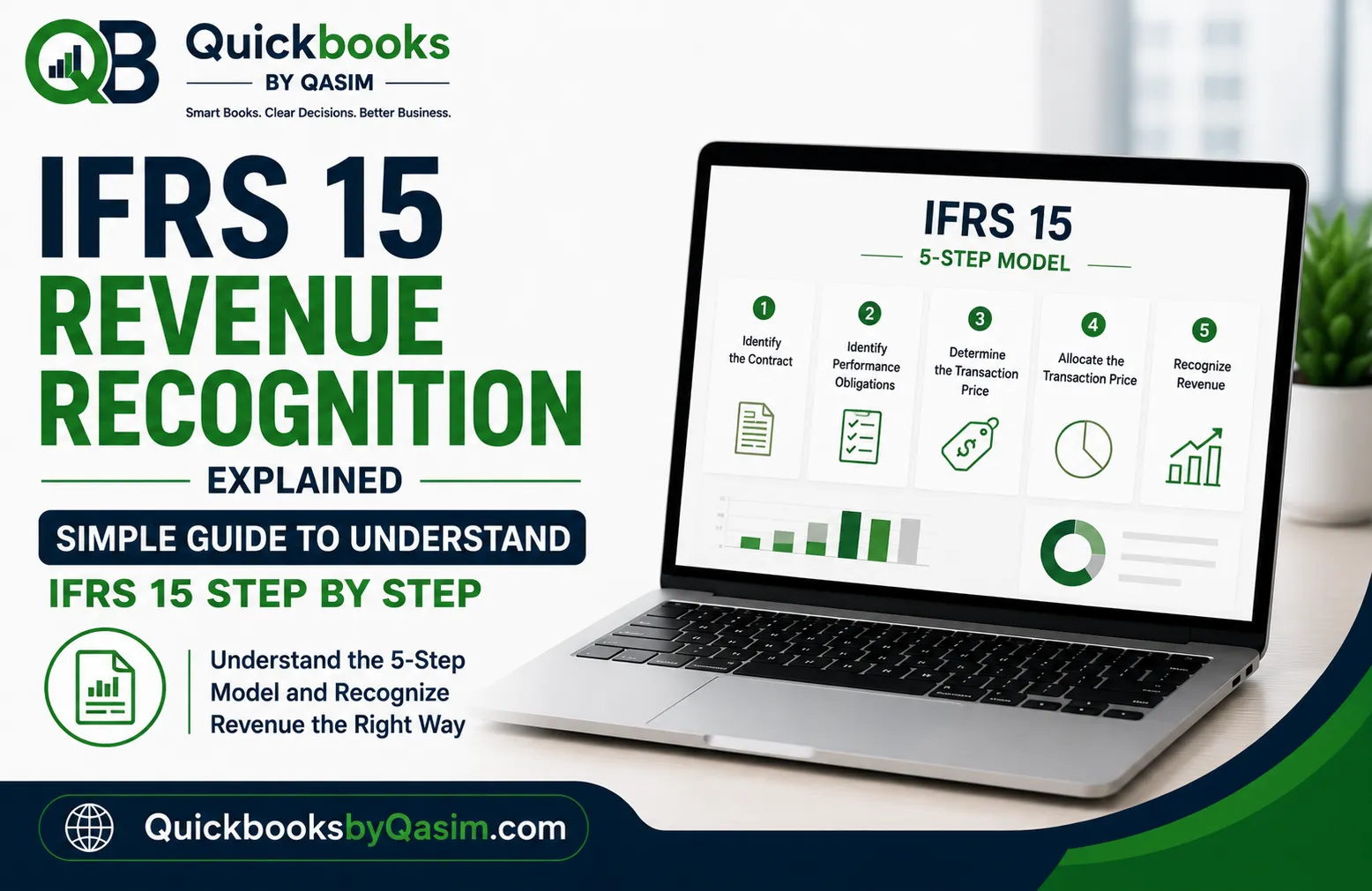
IFRS 15 uses a five-step model.
Follow these steps.
1. Identify the Contract
Find the agreement with the customer.
2. Identify Performance Obligations
List all promised goods or services.
3. Determine the Transaction Price
Find the amount the customer will pay.
4. Allocate the Price
Split the price among obligations.
5. Recognize Revenue
Record revenue when obligations are satisfied.
Understanding the Five-Step Model
The five-step model forms the heart of IFRS 15.
Let’s look at each step in more detail.
Step 1: Identify the Contract
A contract creates rights and duties.
The company agrees to provide goods or services.
The customer agrees to pay.
The contract can be written.
It can also be verbal.
In some cases, it can come from normal business practice.
The contract should meet certain conditions.
For example:
- Both parties approve it.
- Rights are clear.
- Payment terms are clear.
- The contract has business value.
- Collection looks likely.
If these conditions do not exist, revenue should not be recorded yet.
Step 2: Identify Performance Obligations
A performance obligation is a promise.
The company promises to provide something.
That promise can be a product.
It can also be a service.
Sometimes one contract has several promises.
For example, a software company may provide:
- Software
- Installation
- Training
Each item may count as a separate obligation.
The company should review each promise carefully.
Next, it decides if the promises stand alone.
This step helps determine when revenue should appear.
Step 3: Determine the Transaction Price
The transaction price is the amount expected from the customer.
In many cases, this amount seems simple.
However, some contracts contain extra terms.
Examples include:
- Discounts
- Bonuses
- Refunds
- Price reductions
The company estimates these amounts.
Then it calculates the final transaction price.
This step helps create accurate revenue numbers.
Step 4: Allocate the Transaction Price
Some contracts contain several obligations.
The company must divide the price.
It assigns part of the price to each obligation.
Usually, companies use stand-alone selling prices.
Let’s look at a simple example.
A company sells:
- Software for $800
- Training for $200
The customer pays $1,000.
The company allocates revenue based on those values.
This process creates fair reporting.
Step 5: Recognize Revenue
This is the final step.
The company records revenue when it fulfills a promise.
Sometimes revenue appears at one point.
For example:
- Selling a phone
- Delivering furniture
- Shipping a computer
Other times revenue appears over time.
Examples include:
- Cleaning services
- Construction projects
- Long-term support contracts
The company must decide which approach fits the contract.
Revenue Recognized Over Time
Some services take weeks or months.
Customers receive value as work continues.
In these cases, companies recognize revenue over time.
A construction company provides a good example.
The customer gains value during the project.
Revenue can appear as work progresses.
Another example is a maintenance service.
The customer benefits throughout the contract.
Revenue should follow that pattern.
This method gives a fair view of business activity.
Signs Revenue Should Be Recognized Over Time
Revenue may appear over time when:
- The customer receives benefits as work continues.
- The customer controls the asset during work.
- The company cannot easily redirect the asset.
Companies should review contract details carefully.
Then they can choose the correct method.
Revenue Recognized at a Point in Time
Many businesses sell products.
These sales often happen at one point in time.
A customer buys an item.
The company delivers it.
Control transfers.
Revenue appears.
Simple examples include:
- Books
- Computers
- Clothing
- Mobile phones
The key question remains the same.
Has control moved to the customer?
If the answer is yes, revenue can be recognized.
Signs Control Has Transferred
Companies often look for clues.
Common clues include:
- The customer has legal ownership.
- The customer accepted the product.
- The customer carries the risk.
- The customer can use the item.
- The company can demand payment.
These signs help support revenue recognition.
Real-Life Example of IFRS 15
Let’s use a simple case.
A company sells gym equipment.
The contract includes:
- Equipment
- Delivery
- Installation
The customer pays $5,000.
First, the company identifies the contract.
Next, it identifies the obligations.
The equipment is one obligation.
Installation may be another obligation.
Then the company determines the transaction price.
The price equals $5,000.
Next, it allocates the price.
Part goes to the equipment.
Part goes to installation.
Finally, it records revenue.
Revenue for equipment appears when control transfers.
Revenue for installation appears when installation finishes.
This method follows IFRS 15 rules.
Common Industries That Use IFRS 15
Almost every industry uses IFRS 15.
However, some industries rely on it heavily.
Examples include:
- Technology
- Retail
- Construction
- Telecommunications
- Manufacturing
- Transportation
- Healthcare
- Professional services
Each industry may face different challenges.
Still, the same five-step model applies.
That consistency creates stronger reporting.
Common Mistakes
- Recording revenue too early.
- Ignoring contract changes.
- Missing separate obligations.
- Using incorrect transaction prices.
- Forgetting discounts or refunds.
- Misjudging customer control.
- Poor contract reviews.
- Weak documentation.
- Treating all contracts the same way.
- Failing to update revenue estimates.
- Ignoring bonus arrangements.
- Not training accounting staff.
- Using old revenue methods.
- Skipping contract details.
- Rushing revenue decisions.
Helpful Tips
- Read every contract carefully.
- Follow the five-step model.
- Document all revenue decisions.
- Review contract changes quickly.
- Track discounts and refunds.
- Train staff on IFRS 15 rules.
- Keep clear customer records.
- Check performance obligations often.
- Review estimates regularly.
- Use consistent accounting methods.
- Focus on customer control.
- Keep audit evidence organized.
- Monitor long-term contracts closely.
- Ask questions when rules seem unclear.
- Stay updated on IFRS guidance.
Frequently Asked Questions
1. What is IFRS 15?
IFRS 15 is a revenue recognition standard. It tells companies when and how to record revenue from customer contracts.
2. Why is IFRS 15 important?
It creates clear and consistent reporting. Investors and lenders can better understand financial results.
3. What is the main rule in IFRS 15?
Companies record revenue when they satisfy a performance obligation and transfer control to the customer.
4. Does IFRS 15 apply to all industries?
It applies to many industries. However, contract details may differ from one industry to another.
5. What is the five-step model?
The model includes identifying contracts, identifying obligations, determining price, allocating price, and recognizing revenue.
Conclusion
IFRS 15 Revenue Recognition Explained is not as hard as it seems.
The standard gives companies one clear method for recording revenue. Its five-step model helps businesses report revenue in a fair and consistent way.
Remember the key idea. Revenue appears when a company delivers promised value to the customer.
Review contracts carefully. Follow the five steps. Keep strong records.
When you apply IFRS 15 correctly, you’ll create clearer financial reports and build greater trust in business results. That’s a win for companies, investors, and customers alike.
Learn more about the IFRS framework in our What is IFRS? guide.