
Learn IAS 16 Property Plant and Equipment in simple terms. Understand asset recognition, depreciation, measurement, examples,
Qasim Raza | QuickBooks Expert


Financial Management
International Financial Reporting Standards
 By qasimquickbooks416@
September 02, 2026
By qasimquickbooks416@
September 02, 2026
IAS 16 Property Plant and Equipment
 By qasimquickbooks416@
September 02, 2026
By qasimquickbooks416@
September 02, 2026
Have you ever wondered how companies record buildings and machines?
Businesses buy assets to help them earn money. They need clear rules for recording these assets. Without clear rules, financial reports can become confusing.
The quick answer is simple. IAS 16 tells companies how to record and manage property, plant, and equipment.
This accounting standard helps businesses report assets correctly. It also helps investors understand what a company owns.
In this guide, you’ll learn:
- What IAS 16 Property Plant and Equipment means
- Why companies use it
- How asset recognition works
- How depreciation works
- Common mistakes to avoid
- Helpful tips for better accounting
- Answers to common questions
Let’s get started.
What Is IAS 16 Property Plant and Equipment?
IAS 16 is an accounting standard under IFRS.
It provides rules for Property, Plant, and Equipment, often called PPE.
PPE includes long-term assets that help a business operate.
Examples include:
- Buildings
- Factories
- Machinery
- Vehicles
- Office furniture
- Computers
- Equipment
Companies use these assets for more than one year.
They do not buy them for resale.
Instead, they use them to produce goods or provide services.
The purpose of IAS 16 is simple.
It helps companies report assets in a fair and consistent way.
This allows readers to understand:
- What assets the company owns
- How much those assets cost
- How asset values change over time
The main benefit is better financial reporting.
Investors and lenders can make informed decisions when asset information appears clearly.
Why IAS 16 Matters
A company may own expensive machinery.
Another company may own several office buildings.
These assets often represent a large part of total business value.
If companies record assets incorrectly, financial statements may become misleading.
IAS 16 helps prevent this problem.
It creates one clear method for accounting treatment.
As a result, financial reports become more reliable.
Understanding Property, Plant, and Equipment
Property, Plant, and Equipment refers to tangible assets.
Tangible means you can touch them.
These assets support business operations.
A retail store may own shelving units.
A factory may own production machines.
A delivery company may own trucks.
All these items may qualify as PPE.
However, not every purchase qualifies.
The asset must meet certain conditions.
First, the company expects future economic benefits.
Next, the company must measure the cost reliably.
If both conditions exist, the company may recognize the asset.
Examples of PPE
Common examples include:
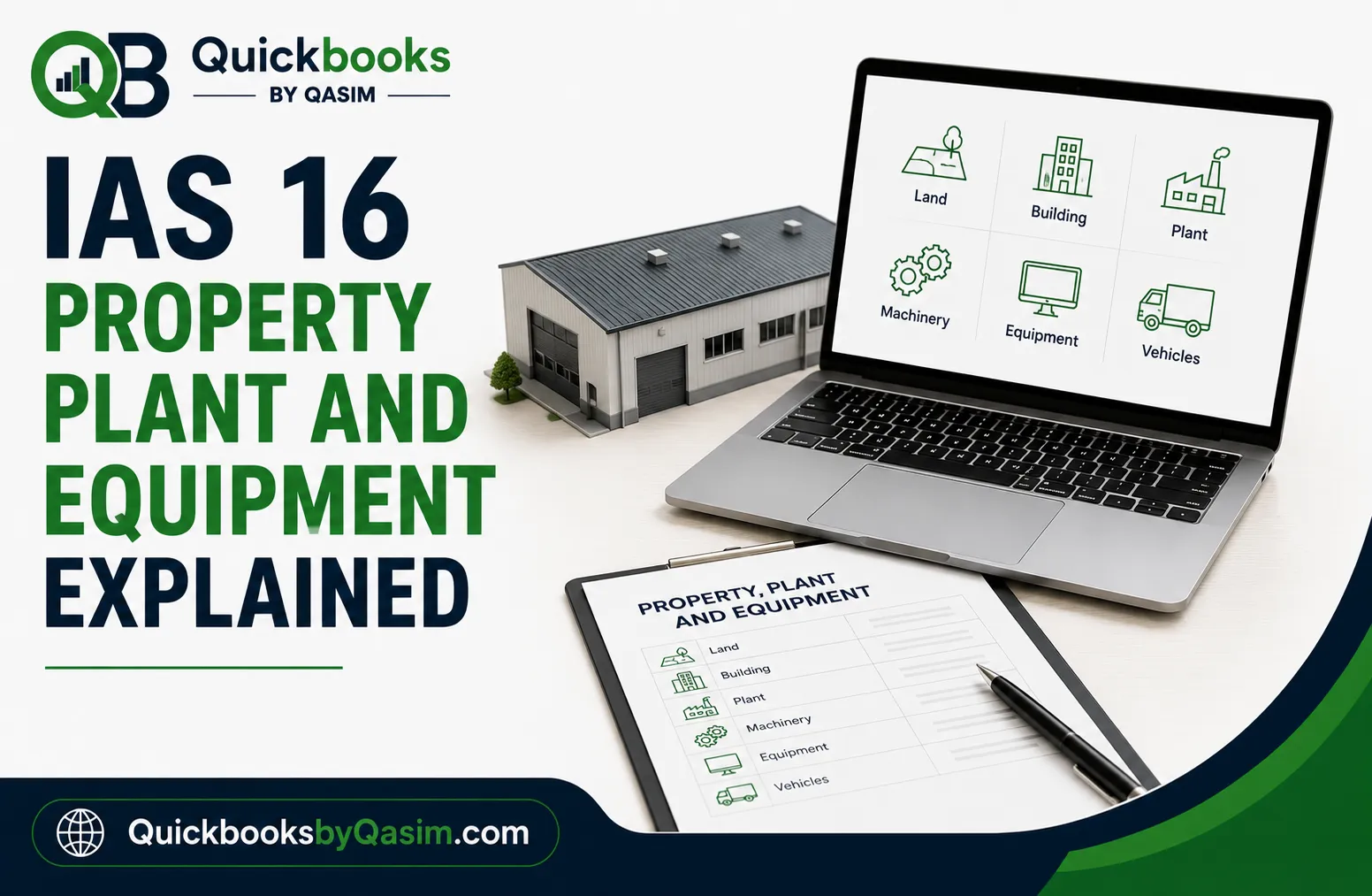
- Land
- Buildings
- Warehouses
- Machinery
- Vehicles
- Furniture
- Production equipment
- Office equipment
Items That Usually Are Not PPE
Some items do not fall under IAS 16.
Examples include:
- Inventory
- Financial investments
- Goodwill
- Intangible assets
- Assets held for sale
Companies should classify assets correctly from the beginning.
This improves reporting accuracy.
Initial Recognition of PPE
IAS 16 requires companies to recognize PPE at cost.
Cost means the total amount spent to obtain the asset.
That cost may include several items.
Examples include:
- Purchase price
- Import duties
- Delivery costs
- Installation costs
- Testing costs
The goal is simple.
Include costs needed to make the asset ready for use.
Example of Initial Recognition
A company buys a machine for $20,000.
Additional costs include:
- Delivery: $500
- Installation: $1,000
- Testing: $500
The total cost becomes $22,000.
The company records the machine at $22,000.
This amount becomes the starting point for future accounting.
Costs Not Included
Some costs should not become part of PPE.
Examples include:
- Staff training
- Advertising costs
- General administration costs
- Business start-up costs
Companies should expense these costs separately.
Benefits of IAS 16 Property Plant and Equipment
- Creates consistent asset accounting.
- Improves financial reporting quality.
- Helps investors understand company assets.
- Shows asset values clearly.
- Supports better business decisions.
- Improves transparency.
- Helps compare companies fairly.
- Tracks asset costs accurately.
- Provides guidance on depreciation.
- Supports reliable financial statements.
- Helps lenders assess business strength.
- Improves compliance with IFRS.
- Encourages proper asset management.
- Creates trust among stakeholders.
- Makes audits easier.
Measuring PPE After Recognition
After recognition, companies continue measuring PPE.
IAS 16 allows two methods.
These methods include:
- Cost Model
- Revaluation Model
Cost Model
Most companies use the cost model.
The calculation is simple.
Asset Value = Cost − Depreciation − Impairment
The company records the asset at original cost.
Next, it deducts depreciation each year.
It also deducts impairment losses when necessary.
This method offers simplicity.
That’s why many businesses prefer it.
Revaluation Model
Some companies choose the revaluation model.
This approach updates assets to fair value.
The company adjusts the asset value periodically.
Fair value reflects current market conditions.
For example, land values may rise over time.
A company may revalue land to reflect that increase.
The company should apply this method consistently.
How to IAS 16 Property Plant and Equipment
- Identify the asset.
- Confirm future economic benefits.
- Measure cost reliably.
- Record the asset at cost.
- Choose a measurement model.
- Calculate depreciation each year.
- Review useful life regularly.
- Check for impairment indicators.
- Update records when assets change.
- Remove assets when disposed.
Depreciation Explained
Depreciation is a key IAS 16 concept.
Assets lose value over time.
Companies spread asset costs across useful lives.
This process is called depreciation.
Why Depreciation Matters
A machine may last ten years.
The company should not expense the full cost immediately.
Instead, it spreads the cost across those years.
This gives a fair view of profit.
Depreciation Example
A machine costs $10,000.
Its useful life equals five years.
The company uses straight-line depreciation.
Annual depreciation becomes $2,000.
The company records this amount each year.
This continues until the useful life ends.
Factors That Affect Depreciation
Companies consider:
- Cost
- Useful life
- Residual value
These factors help determine annual depreciation.
Useful Life and Residual Value
Useful life means expected usage period.
Each asset may have a different useful life.
For example:
- Computers may last five years.
- Vehicles may last eight years.
- Buildings may last many decades.
Residual value also matters.
Residual value means expected value at disposal.
Companies estimate this amount carefully.
Regular Reviews
IAS 16 requires regular reviews.
Companies should assess:
- Useful life
- Residual value
- Depreciation method
Business conditions may change.
Assets may wear out faster than expected.
Regular reviews improve accuracy.
Disposal of Assets
Businesses do not keep assets forever.
Eventually, they sell or retire assets.
IAS 16 provides guidance for disposal.
The company removes the asset from records.
It also removes accumulated depreciation.
Next, it compares proceeds with carrying value.
The difference becomes:
- Gain on disposal
- Loss on disposal
Example
A vehicle has a carrying value of $4,000.
The company sells it for $5,000.
The company records a gain of $1,000.
If the sale price falls below carrying value, a loss occurs.
Proper disposal accounting keeps records accurate.
Practical Example of IAS 16
Let’s look at a simple example.
A manufacturing company buys equipment.
Details include:
- Purchase price: $50,000
- Delivery: $2,000
- Installation: $3,000
Total cost equals $55,000.
The asset qualifies for PPE recognition.
The company records the equipment at $55,000.
The equipment has a useful life of ten years.
The residual value equals $5,000.
Depreciable amount becomes $50,000.
Annual depreciation equals $5,000.
Each year, the company records depreciation expense.
This process continues throughout the asset life.
The financial statements now show accurate asset information.
Common Mistakes
- Recording expenses as assets.
- Ignoring useful life reviews.
- Using wrong depreciation methods.
- Forgetting residual values.
- Missing impairment indicators.
- Including non-qualifying costs.
- Removing assets too late.
- Poor asset documentation.
- Incorrect asset classifications.
- Ignoring disposal accounting.
- Miscalculating depreciation.
- Failing to update estimates.
- Using inconsistent accounting policies.
- Recording inventory as PPE.
- Not tracking asset movements.
Helpful Tips
- Keep detailed asset records.
- Review assets regularly.
- Track depreciation carefully.
- Document all asset purchases.
- Keep supporting invoices.
- Review useful lives annually.
- Monitor asset conditions.
- Separate repairs from capital costs.
- Apply accounting policies consistently.
- Check impairment indicators often.
- Record disposals promptly.
- Train accounting staff.
- Perform asset audits regularly.
- Maintain organized records.
- Follow IAS 16 guidance closely.
Frequently Asked Questions
1. What is IAS 16?
IAS 16 is an IFRS standard for Property, Plant, and Equipment. It explains how companies record and manage tangible assets.
2. What does PPE mean?
PPE stands for Property, Plant, and Equipment. These are long-term assets used in business operations.
3. What is depreciation?
Depreciation spreads an asset’s cost over its useful life. It reflects asset usage over time.
4. Can companies revalue assets?
Yes. IAS 16 allows the revaluation model. Companies may report certain assets at fair value.
5. Why is IAS 16 important?
IAS 16 improves consistency, transparency, and accuracy in financial reporting. It helps users understand company assets better.
Conclusion
IAS 16 Property Plant and Equipment provides clear rules for asset accounting.
The standard helps companies recognize, measure, depreciate, and dispose of assets correctly. It improves transparency and creates reliable financial statements.
Remember the key idea. PPE includes long-term assets that support business operations.
Review asset records regularly. Track depreciation carefully. Apply IAS 16 consistently.
When you follow IAS 16 correctly, you’ll create stronger financial reports and make better business decisions. That’s a valuable step toward accurate accounting and long-term success.
Learn more about the IFRS framework in our What is IFRS? guide.