
Learn IFRS 9 in simple words. Understand financial instruments, expected credit losses, classification rules, and practical
Qasim Raza | QuickBooks Expert


Financial Management
International Financial Reporting Standards
 By qasimquickbooks416@
August 31, 2026
By qasimquickbooks416@
August 31, 2026
IFRS 9 Financial Instruments Guide
 By qasimquickbooks416@
August 31, 2026
By qasimquickbooks416@
August 31, 2026
Have you ever wondered how companies track loans, bonds, and investments?
Many people find financial instruments hard to understand. The rules can seem confusing. This can lead to errors in financial reports.
The good news is that IFRS 9 makes the process easier. It gives clear rules for how companies record and report financial instruments.
In this IFRS 9 Financial Instruments Guide, you’ll learn what IFRS 9 means, why it matters, how it works, common mistakes, and useful tips.
What Is IFRS 9 Financial Instruments?
IFRS 9 is an accounting standard.
It tells companies how to report financial instruments.
A financial instrument is a contract that creates a financial asset for one party and a financial liability for another party.
Some common examples include:
- Loans
- Bonds
- Trade receivables
- Investments
- Bank deposits
The International Accounting Standards Board created IFRS 9.
Many countries use IFRS standards. These standards help businesses create clear financial reports.
IFRS 9 replaced IAS 39.
The older rules were harder to follow. IFRS 9 brought a simpler approach.
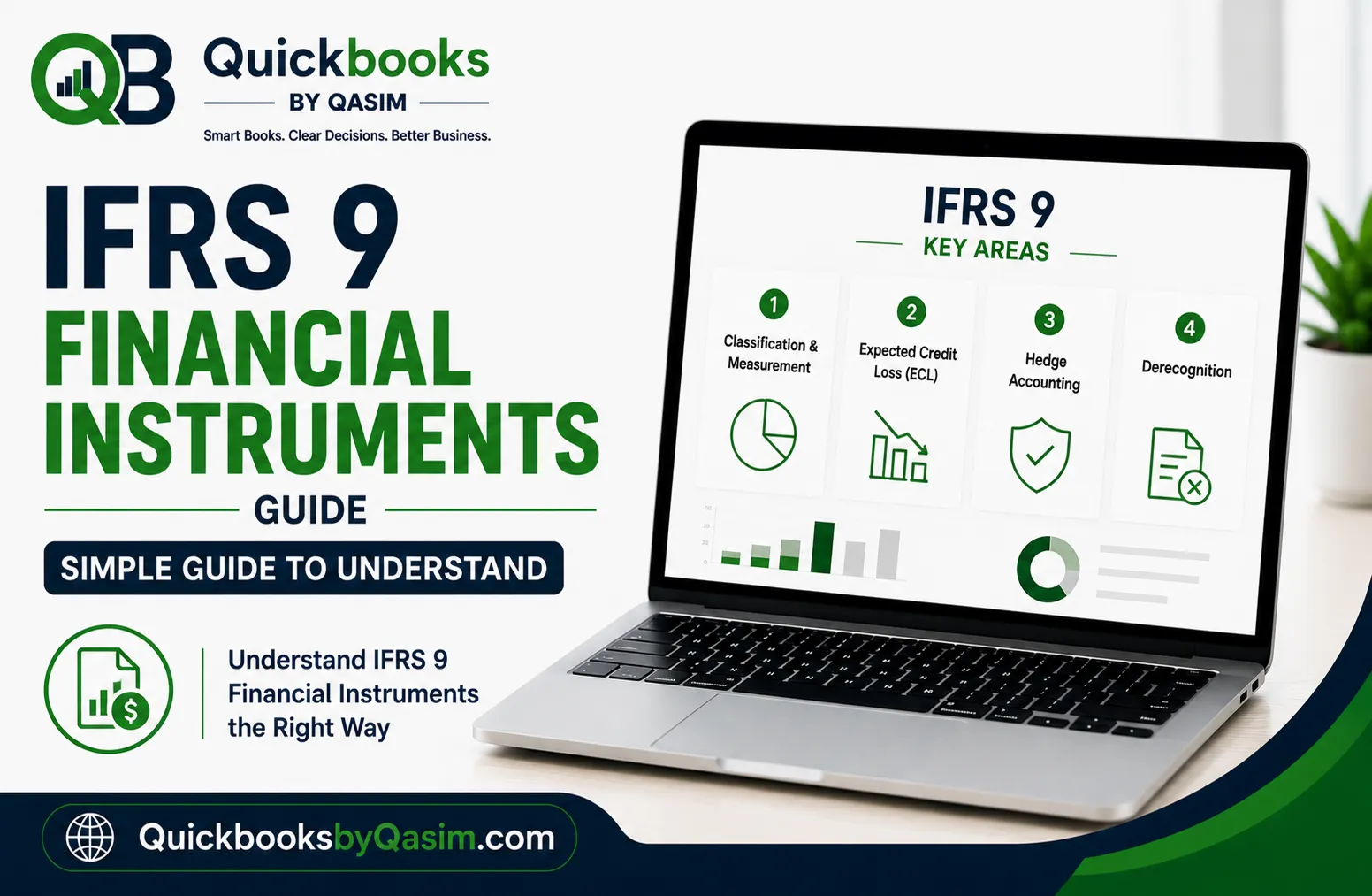
IFRS 9 focuses on three main areas:
- Classification and measurement
- Impairment
- Hedge accounting
Companies use IFRS 9 because investors need reliable information.
Clear reports help people make better decisions.
The main benefit of IFRS 9 is better financial reporting. It helps companies show a true picture of risk and value.
Why IFRS 9 Matters
Financial instruments carry risk.
A borrower may fail to pay a loan.
An investment may lose value.
A company must show these risks in its reports.
IFRS 9 helps businesses identify and report these risks early.
This creates more accurate reports.
It also helps:
- Investors understand performance
- Banks assess risk
- Lenders make decisions
- Regulators review reports
Good reporting builds trust.
Trust helps businesses grow.
Understanding Financial Instruments
Before learning IFRS 9, you should know what financial instruments are.
A financial asset gives value to a business.
Examples include:
- Cash
- Loan receivables
- Bonds
- Shares
A financial liability creates an obligation.
Examples include:
- Bank loans
- Bonds payable
- Trade payables
Companies record these items in their financial statements.
IFRS 9 tells them how to measure and report these items.
This creates consistency across businesses.
Classification and Measurement Under IFRS 9
Classification decides how a company reports a financial asset.
IFRS 9 uses a business model test.
It also uses a cash flow test.
The company asks:
- Why do we hold this asset?
- How will we earn cash from it?
Based on the answers, assets fall into three groups.
Amortized Cost
Companies use this category for assets held to collect cash.
Examples include:
- Trade receivables
- Loans
- Bank deposits
The company records the asset at cost.
Then it adjusts the amount over time.
Fair Value Through Other Comprehensive Income (FVOCI)
Some assets fit this group.
The company may collect cash and also sell the asset.
Changes in value go into other comprehensive income.
This affects equity rather than profit.
Fair Value Through Profit or Loss (FVTPL)
Assets that don’t fit other groups go here.
Changes in value affect profit or loss.
Many investments use this method.
These categories help companies report assets in a uniform way.
Impairment Under IFRS 9
Impairment means a loss in value.
A company may expect some customers not to pay.
IFRS 9 uses an Expected Credit Loss model.
People often call it the ECL model.
The company estimates losses before they happen.
This differs from older rules.
Earlier standards often waited until losses appeared.
IFRS 9 takes action earlier.
This helps companies show risk sooner.
Expected Credit Loss Model
The ECL model looks at future risk.
Companies estimate possible credit losses.
They use:
- Past data
- Current conditions
- Future expectations
For example, a company may have customer invoices.
Some customers may never pay.
The business estimates the likely loss.
Then it records that loss.
This creates more realistic reports.
Three Stages of Credit Risk
IFRS 9 uses three stages.
Stage 1
Credit risk remains low.
The company recognizes a 12-month expected loss.
Stage 2
Credit risk increases.
The company recognizes lifetime expected losses.
Stage 3
The asset becomes credit-impaired.
The company continues to recognize lifetime losses.
These stages help companies measure risk more accurately.
Hedge Accounting Under IFRS 9
Many companies face financial risk.
Exchange rates change.
Interest rates change.
Commodity prices change.
These changes can affect profits.
Companies often use hedging to manage risk.
A hedge helps reduce potential losses.
IFRS 9 provides rules for hedge accounting.
The standard links accounting results with risk management activities.
This makes reports easier to understand.
Common hedging items include:
- Foreign currency contracts
- Interest rate swaps
- Commodity contracts
Hedge accounting helps show the economic purpose of these activities.
Benefits of IFRS 9 Financial Instruments
- Improves financial reporting quality
- Shows risks earlier
- Uses a clear classification system
- Helps investors make decisions
- Supports better risk management
- Creates more transparent reports
- Reduces reporting confusion
- Aligns accounting with business activities
- Encourages early loss recognition
- Builds confidence among stakeholders
How to Apply IFRS 9 Financial Instruments
- Identify financial instruments.
- Review the business purpose.
- Perform the cash flow test.
- Classify each financial asset.
- Measure the asset correctly.
- Assess credit risk regularly.
- Calculate expected credit losses.
- Record impairment amounts.
- Review hedge relationships.
- Update financial reports each period.
Example of IFRS 9 in Action
Let’s look at a simple example.
A company sells goods on credit.
The customer owes $10,000.
The company expects a small risk of non-payment.
After review, it estimates a loss of $300.
The company records an allowance of $300.
The receivable remains at $10,000.
However, the financial statements show the estimated loss.
Investors now see a more realistic picture.
Without IFRS 9, the company might wait until the customer fails to pay.
That could make the risk less visible.
The IFRS 9 approach gives earlier warning signs.
Challenges Companies Face
Some businesses struggle with IFRS 9.
The rules require judgment.
Companies need strong data.
They must estimate future conditions.
They also need systems to track risk.
Small businesses may find this difficult at first.
Still, good planning can help.
Training also makes a big difference.
The more a company understands IFRS 9, the easier compliance becomes.
Common Mistakes
- Using incorrect asset classifications
- Ignoring business model reviews
- Skipping cash flow assessments
- Underestimating expected credit losses
- Using outdated risk data
- Poor documentation practices
- Forgetting regular impairment reviews
- Applying hedge accounting incorrectly
- Failing to monitor risk changes
- Misunderstanding IFRS 9 requirements
Helpful Tips
- Learn the three classification categories
- Review assets often
- Keep clear records
- Monitor customer payment trends
- Update loss estimates regularly
- Use reliable financial data
- Train accounting teams
- Document key decisions
- Check risk changes each reporting period
- Follow IFRS guidance carefully
Frequently Asked Questions
1. What is IFRS 9?
IFRS 9 is an accounting standard for financial instruments. It covers classification, measurement, impairment, and hedge accounting.
2. Why is IFRS 9 important?
It helps companies report financial risks early. This creates clearer and more reliable financial statements.
3. What is an expected credit loss?
An expected credit loss is an estimate of future losses from unpaid debts or failed payments.
4. What replaced IAS 39?
IFRS 9 replaced IAS 39. The newer standard offers a simpler and more forward-looking approach.
5. Who uses IFRS 9?
Companies that follow IFRS standards use IFRS 9. Many businesses around the world apply these rules.
Conclusion
IFRS 9 helps companies report financial instruments in a clear way.
The standard covers classification, measurement, impairment, and hedge accounting. It also helps businesses recognize credit losses earlier.
By understanding IFRS 9, companies can improve reporting quality and manage risk more effectively.
Start reviewing your financial instruments today. The better you understand IFRS 9, the more confident you’ll feel when preparing financial statements.
Learn more about the IFRS framework in our What is IFRS? guide.